A plumber is under a sink, a dentist is with a patient, a home care coordinator is already on another line. The phone rings out, and the caller dials the next business on the list. Missed call text back is the small automation that catches that moment: when a call to your business goes unanswered, the caller gets a text from your business number within seconds, so the conversation keeps going instead of ending in voicemail.
It sounds trivial, and the basic version is. The parts that decide whether it helps or hurts are the ones most vendors skip: how the system knows a call was missed, what happens when the caller is on a landline, and which consent, opt-out and carrier rules apply to a text the caller never asked for in writing. This post covers all three, plus the setup I would use.
How missed call text back works
Every version has the same three parts: detect the missed call, decide whether to text, and send the text from a number the caller recognizes.
1. Detecting the miss
The cleanest setup is a business number that lives on a cloud phone platform and rings your staff from there. On Twilio, for example, the TwiML <Dial> documentation describes an action URL that Twilio requests after the dialed call ends, with a DialCallStatus of values such as completed, busy, no-answer or failed. The same page sets the ring timeout at 30 seconds by default, between 5 and 600 seconds, and notes Twilio adds about five seconds to whatever you set. Your text-back logic simply runs when the status is no-answer or busy.
The other common pattern keeps your existing carrier number and uses conditional call forwarding: unanswered or busy calls forward to a service number that logs the caller and sends the text. It works, but you depend on the carrier passing the original caller ID through.
2. Deciding whether to text
This is the step that separates a useful system from an annoying one. Before sending anything, the logic should check:
- Can the number receive texts? Twilio’s Line Type Intelligence classifies numbers as mobile, landline, fixed VoIP, non-fixed VoIP, toll-free and more, and describes a landline as a number that generally can’t receive SMS. Without a check, the text just fails: Twilio’s error 30006 is returned when the destination is a landline. A landline caller should get a callback task for your team instead.
- Has this number opted out? If someone replied STOP last month, a new missed call is not permission to text again.
- Did they leave a voicemail? If so, the text can say you got it, which feels very different from a generic reply.
3. Sending the text and handing off
The text goes out from the same number they called, so it lands in a thread they recognize. Replies need to reach a human, or an assistant with a clear path to one, and the whole exchange should be logged against the contact.
The missed call text back rules, layer by layer
Three rulebooks overlap here: the federal TCPA and the FCC rules under it, state telemarketing laws, and the carriers’ own registration and consent standards. I covered texting rules in depth for one industry in texting rules for home care agencies. Here I want to focus on what is specific to a text triggered by a call.
Texts count as calls under the TCPA
The FCC’s consumer guide on unwanted robocalls and texts says its rules ban texts sent to a mobile phone using an autodialer unless the owner previously consented or the message is for emergency purposes, and that commercial texts require written consent while consent for informational texts may be oral. The underlying regulation is 47 CFR 64.1200, which defines prior express written consent as a signed written agreement that clearly authorizes marketing messages to a specific number.
Whether a text-back tool is an “autodialer” at all is a real question. In Facebook v. Duguid, decided April 1, 2021, the Supreme Court held that equipment qualifies only if it can store or produce numbers using a random or sequential number generator. A system that only replies to the number that just called does not obviously fit that. I still would not build a business process on that argument, for two reasons. State laws can be broader: Florida’s telephone solicitation statute covers text messages and requires prior express written consent for unsolicited sales calls that use “an automated system for the selection and dialing of telephone numbers.” And the stakes are lopsided: the TCPA’s private right of action allows $500 per violation, up to three times that if the violation was willful or knowing.
Did the caller actually consent?
This is the honest gray area. CTIA’s Messaging Principles and Best Practices, a set of voluntary best practices developed by the wireless industry’s member companies, describe “conversational” messaging as the case where the consumer texts first and the business responds with relevant information, and say no additional permission is expected there. A phone call is not a text, so a missed call text back does not neatly fit that category. The business sends the first text.
My take: a single reply that only acknowledges the call and offers to help is close to the spirit of conversational messaging, but I would rather not rely on “close.” The same CTIA document lists opting in over the phone with interactive voice response (IVR) as a recognized way to consent, and the FCC’s consumer guide names a telephone keypress as one way to give prior written consent for prerecorded telemarketing calls. So my preferred design makes consent explicit:
- The greeting says, “Sorry we missed you. Press 1 and we’ll text you right away, or stay on the line to leave a message.”
- Pressing 1 sends the text and records the keypress, time and number as the opt-in.
- Callers who hang up without pressing anything get the single acknowledgment text only if your attorney is comfortable with it. Otherwise they go on a callback list.
CTIA also recommends documenting opt-in consent by keeping the timestamp, the consent medium, the language and action used to get it, the campaign it applies to and the phone number. A keypress log gives you most of that for free: store the time, the caller’s number, the exact greeting wording they heard and which campaign the keypress opted them into.
Keep it informational, never promotional
The fastest way to turn a harmless text-back into a marketing message is to add an offer. CTIA notes that adding a call to action like a coupon code to an informational text may put it in the promotional category, and that consumers should agree in writing before they get promotional texts. “Sorry we missed you, how can we help?” is informational. “Sorry we missed you, book today and get 15% off!” is a promotion sent to someone who never signed up for promotions. Leave the offers out.
Opt-outs and quiet hours
Under 64.1200(a)(10), people can revoke consent by any reasonable method, and replies of “stop,” “quit,” “end,” “revoke,” “opt out,” “cancel” or “unsubscribe” count as a reasonable means per se. A reply in other words still counts if a reasonable person would read it as a request to stop, and every revocation must be honored within a reasonable time, no more than ten business days. Paragraph (a)(12) allows one confirmation text after an opt-out, as long as it only confirms the request and carries no marketing. In practice, I would sync opt-outs to every tool that texts from your number, not just the one that sent the text-back, so a STOP in one system is not ignored by another. Paragraph (c)(1) of the same section bars telephone solicitations to residential subscribers before 8 a.m. or after 9 p.m. in the called party’s local time. A reply to someone who called you at 10 p.m. is not a solicitation in my reading, but any follow-up nudge (“Just checking in, still need help?”) should wait for business hours, and I would cap follow-ups at one.
Carrier registration: A2P 10DLC
Even a perfectly legal text-back fails if carriers filter it. Twilio’s A2P 10DLC guide says anyone sending texts from an application over a 10-digit number to U.S. recipients must register, and that unregistered traffic gets extra carrier fees. Registration happens through The Campaign Registry, but businesses cannot register directly: your texting provider registers your brand and campaign on your behalf. When you describe the campaign, describe the text-back honestly, including how callers opt in (the keypress) and sample messages that match what you will actually send.
What a good text-back message looks like
| Element | Good | Avoid |
|---|---|---|
| Identity | Starts with the business name | “Hey! It’s us!” |
| Purpose | Acknowledges the call, asks how to help | Discounts, upsells, links to a sales page |
| Next step | Reply here, or a booking link if they asked to book | Five options and a survey |
| Opt-out | “Reply STOP to opt out” | No opt-out instructions |
| Sensitive details | None | Anything about their account, health or money |
A version I would ship, for a made-up dental office: “Hi, this is Northside Dental. Sorry we missed your call. Reply here with what you need and someone will text you back within the hour (8 a.m. to 6 p.m.). Reply STOP to opt out.” If you promise “within the hour,” somebody has to own that promise.
When not to use it
Missed call text back is a good default for service businesses where callers are mostly new customers on mobile phones. It is a poor fit, or needs extra care, in these situations:
- Health information is involved. If you are a healthcare provider, a text thread can become protected health information. Under 45 CFR 164.502(e), a covered entity can only let a business associate create, receive, maintain or transmit protected health information after getting satisfactory assurances, documented in a written agreement, that it will safeguard the data. In practice that means a BAA with the texting platform, and a template that says nothing clinical. My home care texting post walks through that.
- You get spoofed or spam calls. The FCC notes that scammers often use caller ID spoofing. If a spoofed robocall hits your line, your system texts whoever really owns that number, a stranger who never called you. Rate limits, a spam filter and a one-text-per-number window keep this from becoming your own spam problem.
- Nobody will answer the replies. If you cannot staff replies, a text-back just moves the missed connection from the phone to the inbox.
- The real problem is coverage. If you miss half your calls, a text is a bandage. Look at an AI receptionist or the options in my post on covering after-hours calls, where the call is actually answered.
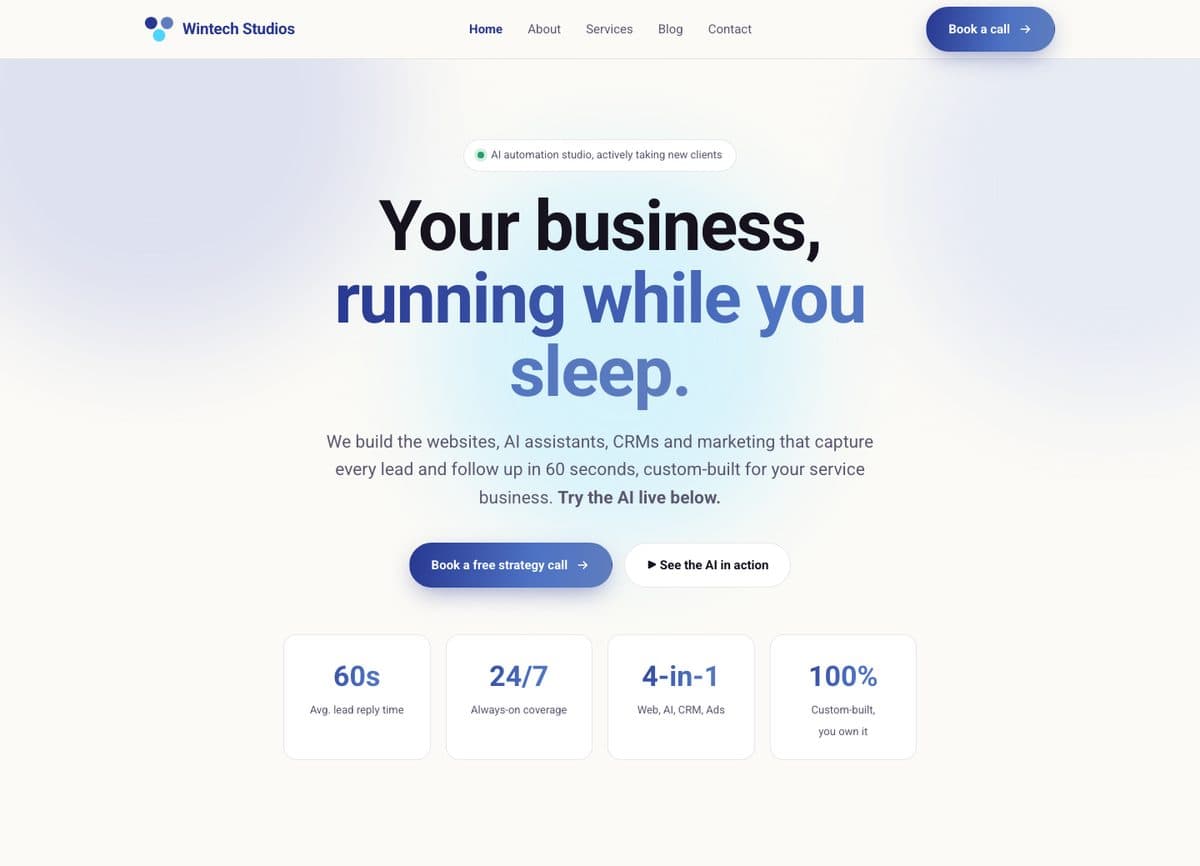
On the other hand, text-back pairs well with an assistant. The text opens the thread, and a scoped assistant can collect the basics and book, with a human taking over for anything unusual. I explain where that line sits in AI agents vs chatbots for small businesses. The Wintech Studios site I built is pitched around exactly this promise, following up every lead within 60 seconds, and that kind of promise only holds if every follow-up channel, text included, is wired to a person or a system that answers.
My setup checklist
- Put the business number on a platform that reports call outcomes, so “no answer” and “busy” trigger the flow and nothing else does.
- Set a ring timeout your team can actually meet before the text fires.
- Add a line type check: mobile numbers get a text, landlines get a callback task.
- Add a keypress opt-in to the greeting and log it as consent.
- Write one informational template with your business name, a single question, a reply-time promise and STOP instructions.
- Block numbers that opted out, and limit to one text per number in a set window, such as 24 hours.
- Route replies to a shared inbox or CRM with a named owner and an alert.
- Register the brand and campaign for A2P 10DLC through your provider, with samples that match the template.
- Hold any follow-up nudges until 8 a.m. to 9 p.m. local time, and send no more than one.
- Review a month of logs: how many texts went out, how many got replies, how many replies were answered on time.
Frequently asked questions
Is missed call text back legal?
It can be, if it is set up carefully. Keep the message informational, identify your business, honor opt-outs, register with carriers, and ideally capture explicit consent with a keypress in your greeting. The risk rises sharply if you add promotions or send repeated follow-ups. State laws vary, so have an attorney check your version.
Does a caller give consent to be texted just by calling?
Not clearly. CTIA treats a reply as conversational when the consumer texts first, and a phone call is not a text. That is why I prefer asking callers to press a key to receive a text, which CTIA recognizes as a way to opt in, and logging it.
Why do some missed call texts never arrive?
The two usual causes are landlines, which generally cannot receive SMS, and carrier filtering of unregistered or poorly described traffic. A line type lookup before sending and a proper A2P 10DLC registration fix most of it.
Want this set up properly?
Missed call text back is a weekend project to switch on and a real project to get right: consent, filtering, routing and someone who answers. If you want help designing it around how your calls actually come in, get in touch and I’ll tell you honestly whether text-back, an AI receptionist or a better callback process fits your business.