A real estate website in Texas has two jobs. It has to sell: show listings, look credible and turn a visitor into a phone call or a showing request. It also has to satisfy the Texas Real Estate Commission, federal fair housing law and the rules of whichever MLS feeds your listings. In my experience the second job gets treated as a footer afterthought.
Here is what I work through when I plan a brokerage or agent website: the TREC homepage links, the advertising rules that shape your branding, what IDX allows, fair housing, and the speed and lead capture work that makes the site pay for itself.
The two TREC links every Texas business website needs
TREC requires two specific links on the homepage of every business website run by a license holder. Both are in Chapter 531 of TREC’s rules, which sit in Title 22, Part 23 of the Texas Administrative Code and are reproduced in full on TREC’s rules page.
Information About Brokerage Services (IABS)
Rule 531.20 says each license holder must provide a link to a completed IABS Notice “in a readily noticeable place on the homepage of each business website.” The label has to be either “Texas Real Estate Commission Information About Brokerage Services” in at least 10 point font, or “TREC Information About Brokerage Services” in at least 12 point font. The current form is on TREC’s IABS form page.
Two details trip people up. First, it has to be a completed notice, not TREC’s blank form; the rule lets you reproduce the form only verbatim and identical in layout, with the Broker Contact Information section prefilled, so I host a filled-in PDF and link to that. Second, the exact label matters: “Agency Disclosure” or a tiny “IABS” in the footer is not what the rule describes.
Consumer Protection Notice
Rule 531.18 works the same way for TREC’s Consumer Protection Notice: a link in a readily noticeable place on the homepage, labeled “Texas Real Estate Commission Consumer Protection Notice” in at least 10 point font, or “TREC Consumer Protection Notice” in at least 12 point font. The rule also requires it to be displayed in each place of business.
TREC’s own tips for posting the IABS and Consumer Protection Notice also allow posting an image of the completed form, labeled with the same wording, which is useful on social platforms.
What counts as a “business website”
Both rules define a business website as one that is accessible to the public, contains information about a license holder’s real estate brokerage services, and whose content is controlled by the license holder. TREC’s FAQ is explicit that the IABS link applies to “each broker and sales agent,” so an agent’s personal site counts, not only the brokerage’s main domain. For social media, both rules allow the link to live on the account profile, or on a separate page reached by a direct link from the platform or profile.
My default is a clearly labeled row of links above the copyright line, at a normal reading size with real contrast, so it is on the homepage and every other page. It reads as professional, not hidden.
TREC advertising rules that shape your branding
Rule 535.155 defines an advertisement as “any form of communication by or on behalf of a license holder designed to attract the public to use real estate brokerage services,” and the list explicitly includes the Internet, social media, email and text messages. As I read it, that makes your website, and every listing and landing page on it, an advertisement.
The rule requires each advertisement to show, in a readily noticeable location, the name of the license holder or team placing it, and the broker’s name in at least half the size of the largest contact information for any sales agent, associated broker or team name in the ad. That has real design consequences:
- Agent and team sites need the broker visible. If an agent’s name is a big logo in the header, the broker’s name has to be there too, at no less than half that size.
- Team names have limits. The rule treats as misleading a team name with terms that imply the team offers brokerage services independent of its sponsoring broker, and it gives “brokerage,” “company” and “associates” as examples.
- Titles matter. It also treats as misleading an ad that uses a title such as owner, president or CEO, or an email or website address, that implies a sales agent is responsible for running the brokerage.
- Stale listings are an advertising problem. Under the same rule, it is misleading to keep advertising a listed property that is not taken down within 10 days after the listing agreement ends, or to advertise a property 10 days or more after closing unless the ad shows its current status.
That is why I treat listing data as a system to maintain, not a page to publish. If you are using assumed or team names, rule 535.154 covers how those must be registered with TREC, and it is worth reading alongside 535.155.
IDX: what you can and can’t do with listing data
IDX (Internet Data Exchange) is how a brokerage displays other brokers’ listings from the MLS on its own site. The baseline rules for MLSs affiliated with the National Association of REALTORS® are in NAR’s IDX policy (Policy Statement 7.58). Your local MLS can add its own requirements on top. The points that most affect how I build:
- Refresh at least every 12 hours. The policy says participants must refresh all MLS downloads and the displays fed by them “not less frequently than every 12 hours.”
- Credit the listing firm. Each IDX display must identify the listing firm in a reasonably prominent location, in a readily visible color and a typeface “not smaller than the median used in the display of listing data.”
- Don’t edit other brokers’ listings. The policy says participants shall not modify or manipulate information relating to other participants’ listings. You can wrap them in your own design, but the data itself stays as the MLS provides it.
- Filter only on objective criteria. You may choose which IDX listings to show, but only on objective criteria such as geography, list price, property type or listing type.
- Keep agent-only fields private. The policy’s guidelines call for MLSs to prohibit displaying confidential fields intended for cooperating brokers, such as showing instructions and property security information.
Plugin, iframe or direct feed
In my experience brokerages get listings onto a site in one of three ways. An embedded vendor widget or iframe is fastest to launch, but you inherit the vendor’s design and speed, and the listing pages often don’t live on your domain. A WordPress IDX plugin puts pages on your domain but tends to add heavy scripts. A direct feed into a custom site needs MLS approval and more build work, but gives full control over design, speed and lead capture. I compare the platforms in Next.js vs WordPress vs Webflow vs Framer.
Fair housing applies to your copy, photos, forms and ads
The federal Fair Housing Act makes it unlawful to publish any notice, statement or advertisement about the sale or rental of a dwelling that indicates a preference, limitation or discrimination based on race, color, religion, sex, handicap, familial status or national origin (42 U.S.C. 3604(c)). HUD’s regulation, 24 CFR 100.75, spells out what that covers, and it reads like a website checklist:
- Using “words, phrases, photographs, illustrations, symbols or forms” which convey that dwellings are or are not available to a particular group.
- Selecting media or locations for advertising that deny particular segments of the housing market information about housing opportunities.
On a website that translates into a few habits I follow. Neighborhood and listing copy describes the property and the area, not the kind of buyer it suits. Lifestyle photography is varied and doesn’t suggest who belongs. Lead forms ask about the home someone wants (budget, area, timing, bedrooms) and never about protected characteristics. And paid ad targeting gets reviewed with the same regulation in mind, because the rule specifically names the choice of media and locations.
What changed with HUD’s digital advertising guidance
In April 2024 HUD issued guidance on how the Fair Housing Act applies to advertising housing through digital platforms. In a Federal Register notice published April 6, 2026, HUD said it had withdrawn that guidance, along with seven other documents, effective September 17, 2025. The same notice says actions that do not comply with the text of the Fair Housing Act continue to be subject to enforcement, and that complainants can still file a civil action within two years. The guidance is gone. The statute and 24 CFR 100.75 are not, so I build and review ad campaigns exactly as carefully as before.
Speed: listing sites are heavy by nature
Listing pages are image galleries with maps attached, close to a worst case for performance. Google’s Core Web Vitals documentation recommends a Largest Contentful Paint within 2.5 seconds, an Interaction to Next Paint under 200 milliseconds and a Cumulative Layout Shift under 0.1, and says good Core Web Vitals align with what its core ranking systems seek to reward. I explain them in Core Web Vitals explained for business owners.
What I do on listing sites specifically:
- Serve photos at the size they display, in modern formats, with the first photo prioritized and the rest lazy loaded.
- Load maps on demand. A map script on every page, including ones without a map, is one of the most common slowdowns I see.
- Reserve space for images and badges so the page doesn’t jump when “New” or “Price reduced” labels arrive.
Lead capture that respects the visitor
In my experience, forced registration walls that pop up after two listing views generate a lot of fake email addresses and not many real conversations. What works better on the sites I build:
- A clear action on every listing: “Schedule a showing” and “Ask about this home,” with the listing ID passed into the form automatically so the agent knows exactly what the person was looking at.
- Saved searches and alerts as the reason to create an account.
- Fast routing: leads go straight to the right agent’s phone and into a CRM, with a record of which listing and page they came from. I wrote about choosing that system in custom CRM vs off-the-shelf.
- Consent in writing before any automated texts or calls, captured next to the phone field.
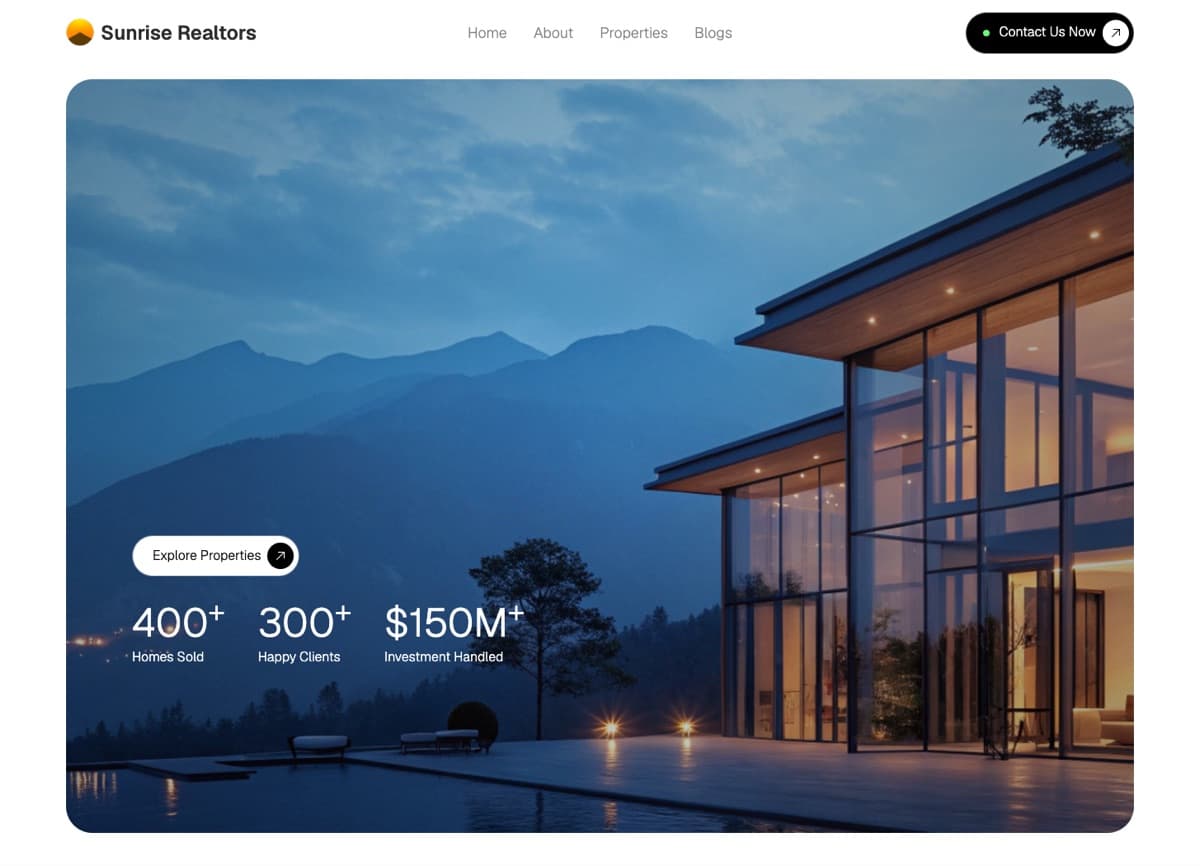
On Sunrise Realtors, a brokerage in Allen, Texas, I handled the brand development, the web experience and AI integration. The homepage leads with property imagery and a single “Explore Properties” action, with the contact button kept visible in the header, which is the pattern I come back to: one clear next step, always in reach.
If you are budgeting for a build like this, I break down typical cost drivers in what a website costs for a Dallas small business.
Frequently asked questions
Does a Texas real estate agent’s personal website need the IABS link?
Rule 531.20 applies to each license holder and each business website the license holder controls, and TREC’s FAQ says each broker and sales agent must provide the link on its homepage. If you run the site, plan on including both the IABS and Consumer Protection Notice links.
Can I show sold listings on my website?
Rule 535.155 treats it as misleading to advertise a property 10 days or more after closing unless the current status is included, and to keep advertising a listing more than 10 days after the listing agreement ends. As I read it, the risk is a sold home that still looks available, so I label sold properties clearly and take down stale “for sale” pages. Your MLS rules also govern what sold data IDX may display.
Is fair housing advertising law still enforced after HUD withdrew its guidance?
Yes. HUD withdrew its 2024 digital advertising guidance effective September 17, 2025, but its notice says actions that don’t comply with the Fair Housing Act remain subject to enforcement, and private lawsuits remain possible. The statute, 42 U.S.C. 3604(c), and HUD’s regulation, 24 CFR 100.75, still apply to your website copy, photos, forms and ads.
Want a second look before you launch?
Most brokerage sites don’t need a rebuild to fix these. They need two labeled links, a broker name resized, a stale listings section replaced with a live feed, and a faster listing page. If you’d like me to go through your site and tell you what I’d fix first, get in touch.