Most goal apps are built for people who are already good at goals. They give you a blank list, a streak counter and a progress bar, then quietly punish you the first time life gets in the way. I wanted to build the opposite: an app for the person who has written “get fit” or “finish the book” at the top of a page more times than they’d like to admit.
That app is Tackie, live at tackie.io. You describe a goal in plain words, it sharpens the goal through a short conversation, breaks it into a small weekly plan, and shows your progress as a climber working up a painted mountain. I built it at Pinn.Media as our own product, with nobody else’s brief in the way. This post is the story of how it came together, what I chose not to build, and the research I leaned on along the way.
Why I built a goal app at all
At Pinn.Media we build brands, websites and software for clients. I wanted proof of that work end to end, in a single product we owned: a brand, an app, an AI pipeline that is safe and cheap enough to offer free, and a site that brings people to it. A goal planner was a good test because it touches everything. It needs warmth in the brand, care in the AI, solid engineering underneath and a landing page that is honest about what the product is.
It also scratched a personal itch. I split my week between my role as Solutions Architect at Lonestar Home Healthcare, running Pinn.Media and building Nuraflow. With a week that full, “get stronger” isn’t a plan. It’s guilt. I wanted a tool that turns it into something I can start on Tuesday.
The project began as a proof of concept called Ascent in mid-June 2026. I renamed it Tackie the next day, and the core product came together over the following fortnight across nearly four hundred commits.
Who Tackie is for
The landing page says it plainly: “You’re not bad at goals. The tools were.” I wrote it for four kinds of people:
- People frozen by big goals. A goal like “write the book” is too big to start, so they don’t. Tackie hands them only the next small step.
- People who start strong, then fizzle. Week one goes well, then life happens and the plan stops fitting. Tackie checks in each week and reshapes the plan instead of ending it.
- People with ADHD who need the structure held for them, rather than having to rebuild it every morning.
- Anyone who quits after one missed day, because the app made that day feel like failure.
The site also says clearly that Tackie is not medical advice. A goal app will get health goals, and I didn’t want anyone mistaking a planning tool for a clinician.
The core loop: sharpen, plan, reckon
Everything in Tackie hangs off three steps. I kept them deliberately simple, because the people I’m building for don’t need more features. They need less friction.
Sharpen: one question at a time
You type a goal however it comes out. Vague is fine. Tackie then asks one question at a time until the goal is specific enough to start. The model decides how many questions it needs, so a clear goal gets through quickly and a fuzzy one gets a little more help.
I chose one question at a time on purpose. In my experience, a form with eight fields is exactly the kind of wall that stops someone who is already hesitant. A conversation that asks one thing, listens, then asks the next feels more like talking to a friend who is good at planning.
A safety screen runs before any of this. If someone sets an unsafe target, say a crash diet, Tackie gently reframes it toward a sustainable pace. If the goal is impossible as stated, it talks it down to a real first step. I didn’t want an eager AI cheerfully helping someone hurt themselves.
Plan: small enough to begin today
Each week is three to five tasks. Every task is a single sitting you can tick yes or no, and the first one is whatever is currently in your way. How many tasks you get, and how hard they are, depends on how much time you have and the intensity you chose. The tasks are placed in your free windows, so the plan fits the week you actually have.
The research I kept coming back to here is on implementation intentions: plans of the form “if situation Y happens, then I will do behaviour Z.” Peter Gollwitzer and Paschal Sheeran’s 2006 meta-analysis of 94 independent studies found a medium-to-large positive effect of these plans on goal attainment (d = .65). The National Cancer Institute’s summary of the construct reports the same review found medium-to-large effects both on getting started and on keeping people from being derailed.
I’m not a psychologist, and I don’t claim Tackie recreates those studies. But a task that lives in a specific slot in your week is much closer to “if it’s Tuesday at 7, then I go for the walk” than a floating to-do item is.
Tasks also go where your life already happens. Tackie offers calendar links and an .ics feed, using the iCalendar format defined in RFC 5545, so your plan can sit in the same calendar as your meetings. Web push reminders nudge you when a task is due.
Reckon: next week is written from this week
At the end of each week, you tell Tackie how it went: Proud, Steady, Tired or Rough. Next week is then written from that answer, not from the plan you had. A rough week gets a lighter plan. A proud one can stretch a little. There is also a “lighten this week” rescue for the moments mid-week when everything has gone sideways.
Forgiving streaks, and the research behind them
Streaks are powerful and cruel. They work right up until the day you miss, and then a 40-day streak resetting to zero can feel like proof you were never going to manage it. Tackie never breaks your streak for missing a day.
That choice has some backing. In a 2009 study in the European Journal of Social Psychology, Phillippa Lally and colleagues followed volunteers who each chose a daily eating, drinking or activity behaviour for 12 weeks. The time it took participants to reach 95% of their peak automaticity ranged from 18 to 254 days, and missing one opportunity to perform the behaviour did not materially affect the habit formation process.
Two things from that paper shaped Tackie. First, change can take a long time, and the range is huge, so the app shouldn’t promise a magic number of days. Second, a single miss is not the disaster most streak counters treat it as. A product that resets you to zero is punishing something the research suggests doesn’t matter much.
The climb: progress you can see
A progress bar tells you what you haven’t done. A climb shows you what you have. That idea is the visual heart of Tackie.
The scene is built from painted layers: sky, mountain, ground, sun or moon, clouds and a climber. It turns from day to night with your local clock. Finishing this week’s tasks brightens the sun and clears the clouds. Your overall progress walks the climber along a trail traced from the painting, and reaching the summit triggers a victory pose and a burst of colour. Alongside it sits an Ascent Score that rises as you check things off.
I animated the scene with plain CSS rather than a heavy 3D engine, so it runs smoothly on an ordinary phone. Under reduced-motion settings, the whole thing holds still. That follows the prefers-reduced-motion media feature in the W3C Media Queries Level 5 specification, which lets a site detect when someone has asked their device for less motion. For an app aimed partly at people who feel overwhelmed easily, respecting that setting wasn’t optional.
Years of physical and interactive projects, like the ones I wrote about in designing tangible technology, taught me that people respond to things that feel alive. A mountain you are climbing is a story. A percentage is a statistic.
The AI underneath, kept honest and affordable
Tackie runs on Next.js, Supabase and Claude. The AI decisions came down to two constraints: it had to be trustworthy, and it had to be cheap enough to run for free.
- Two model sizes. The heavy reasoning, like sharpening a vague goal, uses a larger Claude model. Quick jobs such as planning, the safety check and weekly insights use a smaller one. That split is what makes a free tier realistic.
- Numbers come from code, not the model. Statistics are computed in code, and the model only narrates them. Language models can be confidently wrong about arithmetic, and I didn’t want Tackie ever telling someone they’d done more or less than they had.
- The model doesn’t get the final word on safety. The safety screen runs first, before the planning conversation, rather than being something the planner is merely asked to keep in mind.
I’m wary of adding AI for its own sake, which I’ve written about in why most small businesses don’t need AI yet. Tackie is a case where it earns its place: turning a sentence like “sort my life out” into three concrete tasks is genuinely hard to do with rules alone. The same discipline of keeping the model on a short leash is what I used when I built an AI receptionist for a home healthcare agency.
Accounts, privacy and the boring parts that matter
You don’t need an account to try Tackie. The try-it mode lets you sharpen a goal and see your first week, and the draft stays on your device. When you do sign up, there is Google sign-in and two-factor authentication.
Every table in the database has row-level security enabled. Supabase’s own row-level security guide recommends enabling RLS on every table in an exposed schema, and warns that a table without it is readable and writable by any role with a grant on it. For an app holding people’s personal goals, that was the baseline, not an extra.
Around the core I also built a Pomodoro timer for focused sessions, a changelog, admin tools and a small chat helper on the landing page called Ranger. Today Tackie installs as a web app, and native iOS and Android apps are on the way.
Designing the brand and the landing page
The brand is warm and aimed at a younger audience: electric violet with mint, banana and pink used sparingly, and Bricolage Grotesque for headings. One rule I set early is that no screen ever uses every accent colour at once. It’s the kind of constraint I describe in my guide to designing a brand identity system, and it keeps a playful palette from turning into noise.
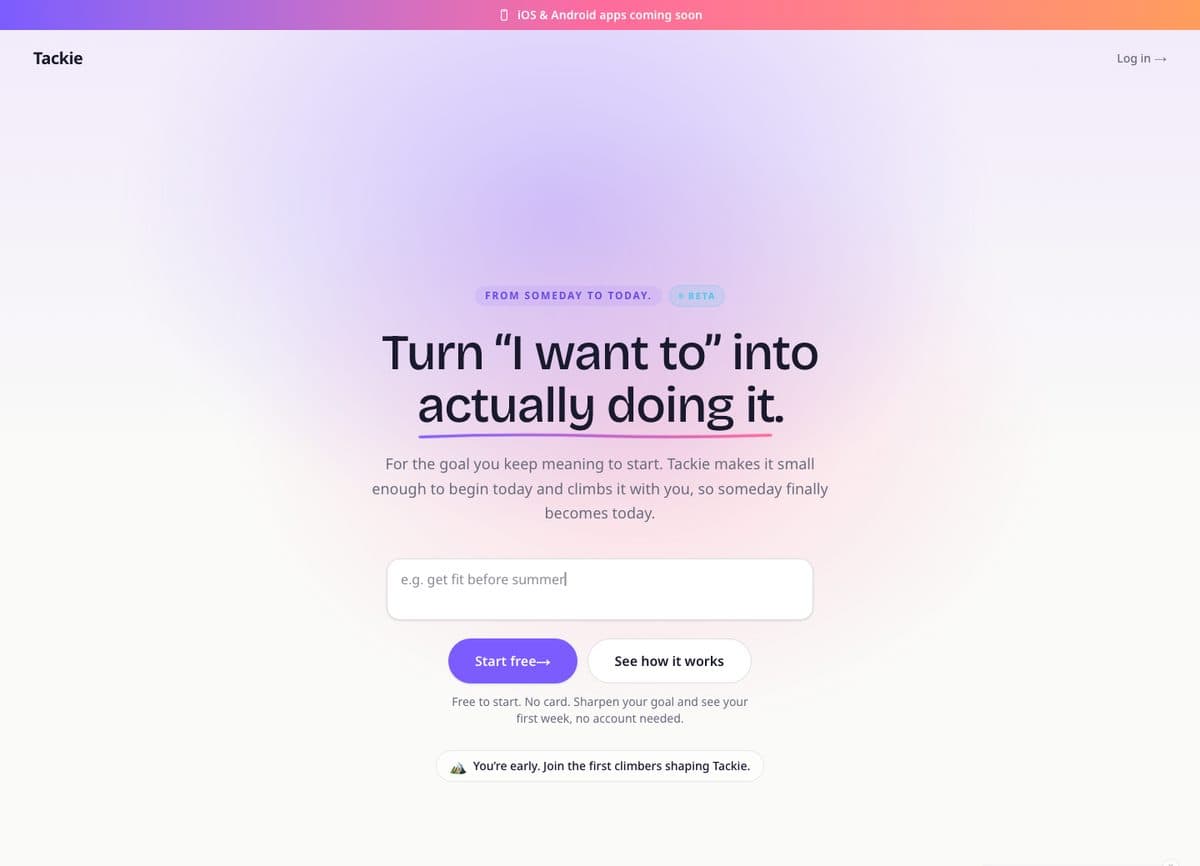
The hero reads “Turn ‘I want to’ into actually doing it,” with a text box where you can type your goal straight away. Below it, the page explains how it works, offers a live preview, and answers the questions people ask first: price, privacy, and how Tackie differs from asking a general chatbot.
I was careful about honesty. Tackie is in beta, it is free to start, and it is early. The landing page says “You’re early. Join the first climbers shaping Tackie.” I don’t quote user numbers or results, because it would be dishonest to dress up a beta as something it isn’t yet.
Frequently asked questions
What is Tackie?
Tackie is a goal app I built at Pinn.Media. You describe a goal in plain words, it sharpens the goal through a short one-question-at-a-time conversation, gives you three to five small tasks a week placed in your free time, and shows your progress as a climber scaling a painted mountain.
Is Tackie free?
Tackie is in beta and free to start. You can sharpen a goal and see your first week without creating an account, and the draft stays on your device until you decide to sign up.
What happens if I miss a day or have a bad week?
Your streak doesn’t break for a missed day. At the end of each week you tell Tackie how it went, and next week is written from that answer, so a rough week leads to a lighter plan. A missed week makes the trail longer, but the climber never slides back down.
Try the climb
If you have a goal you keep meaning to start, Tackie is free to try at tackie.io, no account needed. And if you’re thinking about building a product of your own, with a brand, an app and AI that behaves itself, you can see the full Tackie case study or get in touch and I’ll tell you honestly what I’d build first.