Most owners who ask me for a rebrand actually need a refresh, and a few who ask for a refresh are quietly avoiding a rebrand they need. The rebrand vs refresh decision is not about how tired the logo looks. It is about which layer of the brand is failing: the name and the promise, or the way they are being expressed.
Here is how I diagnose that, what each option costs once you count Google, your domain and your trademark, and when to do neither.
Rebrand vs refresh: the difference is depth, not size
I think of a brand as five layers, stacked from the hardest to change to the easiest:
- Name: what people say, search and write on a cheque.
- Positioning: who you are for and why they should pick you over the next option.
- Core mark: the logo’s basic idea and silhouette.
- System: colour, type, layout, imagery, voice.
- Applications: the website, signage, social templates, forms, uniforms.
A refresh changes layers 4 and 5, and maybe redraws layer 3 without changing its idea. People who know you should still recognise you instantly. A rebrand changes layer 2 at minimum, and usually 3, sometimes 1. People who know you should notice that something about the business itself has changed.
The useful question is never “do we need something new?” It is “which is the highest layer that is actually broken?” Fix that layer and everything below it. Leave everything above it alone.
Signs you need a refresh
A refresh is the right call when customers understand what you do and choose you for the right reasons, but the expression is letting you down. The signals I look for:
- It breaks at small sizes. The logo turns to mush as a favicon, social avatar or embroidered patch. That is a drawing problem, not an identity problem.
- It is inconsistent. Three greens, four fonts, and a flyer someone made in a hurry that now looks more “official” than the website.
- It fails on screens. Text colours that are hard to read. WCAG asks for a contrast ratio of at least 4.5:1 for normal text, and a palette built for print often misses it. The same criterion exempts logo text, so the fix is usually the system around the mark.
- It looks dated next to the work. The service has improved and the visuals have not caught up.
None of those are reasons to change your name or your story. They are reasons to tighten the system and document it. If that sounds like you, my logo design process covers the stress tests I run when redrawing a mark, and they work just as well on an existing one.
Signs you need a rebrand
A rebrand is justified when the problem sits at the positioning or name layer. In my experience that looks like:
- The business has changed shape. You started as one service and now sell three, or you moved from consumers to institutional buyers, and the brand still describes the old company.
- You are winning the wrong customers. The brand attracts price shoppers when your margins depend on people who want quality, or the reverse.
- The public face contradicts the product. Not just “old,” but actively saying the opposite of what you sell.
- The name is a liability. It is confusingly close to someone else’s, it limits you to a city or service you have outgrown, or it carries baggage from a merger or a former owner.
- Nobody can say what you stand for. Ask five staff members to describe the business in a sentence. If you get five unrelated answers, new colours will not fix it.
What I learned rebranding PrintVision without renaming it
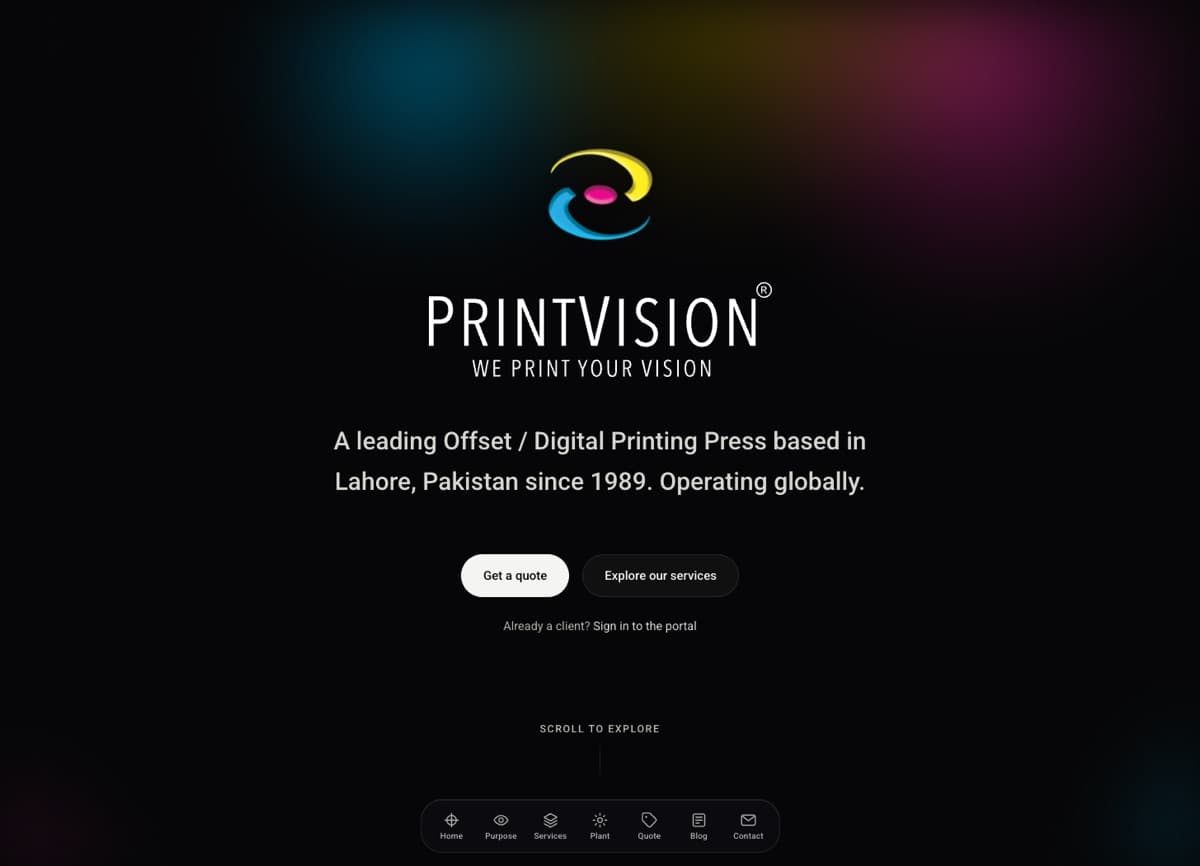
The clearest example in my own work is PrintVision, my family’s printing and packaging house in Lahore. It had already been renamed once, from Farooq Trading Corporation to PrintVision in 2011, along with the line “we print your vision.” When I took on the work in 2026, the name was not the problem. The positioning was.
The company ran six offset presses and had pharmaceutical manufacturers on its client list, but the website treated those clients as a logo strip near the footer and its stat counters rendered as broken text like “0M+”. A printer whose own site shows a printing error is contradicting the one thing it sells. That is a layer 2 failure, so a refresh would have been lipstick.
So we kept layer 1 and rebuilt everything beneath it. The positioning became one line, “pharma first, never pharma only.” A twenty-five-section brand foundation was written before any drawing. Then came a new mark built from the CMYK process, a type system, collateral, a film and a new site. Keeping the name preserved thirty-plus years of recognition with existing buyers; changing everything else gave procurement teams a reason to look again.
The lesson I took from it: a rebrand does not have to include a rename. The name is the most expensive layer to touch, and you should only touch it when it is the thing that is broken.
What a name change really costs
This is the part owners underestimate. Visual changes cost design time. A name change costs you things you have already earned, and some of the bills come from outside your business.
Your Google Business Profile may start over
Google’s Business Profile guidelines allow a “rebranding” edit only for a minor name change, where the proper nouns and services in the name stay the same and the business category stays the same. If your change does not meet that, Google treats it as a new business: you mark the existing profile as closed and create a new one. For a local service business, that profile is often the main source of calls, so this alone can decide the question.
A new domain is a site move
If the name changes, the domain usually follows. Google’s guidance on moving a site with URL changes says to use permanent server-side redirects (301 or 308) from old to new URLs, submit a Change of Address in Search Console for every verified variant of the old domain, and keep redirects “generally at least 1 year.” It also says to expect temporary ranking fluctuation during the move. Separately, Google picks the site name shown in results from WebSite structured data and other home page signals, and notes recrawling can take several days to several weeks. Plan for a period where search shows the old and new names side by side.
The trademark question
Before you fall in love with a new name, search it. The USPTO recommends a comprehensive clearance search for confusingly similar marks used with the same or related goods and services, to avoid a refusal, an opposition or cancellation, or an infringement lawsuit. Its federal database is not the whole picture: the USPTO notes that common law rights come from use in commerce in a geographic area, and encourages searching the internet, state trademark databases and business name databases too.
If you already hold a federal registration, a deep logo change matters there as well. Under 15 U.S.C. § 1057(e), a registration can be amended only if the amendment “does not alter materially the character of the mark.” My reading: a refresh that keeps the mark’s essential look may be fine, while a genuinely new mark likely needs its own application. That is exactly the kind of thing to confirm with an attorney before launch, not after.
Refresh vs rebrand side by side
| Refresh | Rebrand (same name) | Rebrand (new name) | |
|---|---|---|---|
| Layers changed | System, applications, maybe a redrawn mark | Positioning, mark, system, applications | Everything |
| Recognition kept | Almost all | Name and reputation | Only what you carry over deliberately |
| Google Business Profile | Update photos and logo | Update photos and logo | Rename edit or a new profile, per Google’s rules |
| Website and domain | Restyle, same URLs | Often a rebuild, same domain | Usually a site move with redirects |
| Trademark work | Usually little | New mark may need a new filing | Clearance search and new filing |
| Customer explanation | None needed | A short “what’s new” story | A deliberate announcement |
When to do neither
Some of the strongest advice I give is to leave the brand alone. Do neither when:
- The real problem is the website. A slow, confusing site makes a good brand look bad. Fix the site first; my website redesign checklist starts with exactly that diagnosis.
- The real problem is consistency. If the brand is fine but everyone uses it differently, you need guidelines and templates, not new artwork.
- You are bored, not your customers. You see your logo every working day; most customers see it only when they need you. Fatigue on the inside is not evidence of a problem on the outside.
- You are about to change the business. If a merger, new service line or new market is coming within the year, wait and rebrand once around the new shape.
A 30-minute diagnostic you can run this week
Before you brief anyone, work through this with one or two people who deal with customers every day:
- Write the one sentence. Who you serve, what you do, why you over the alternative. If you cannot agree on it, the problem is positioning.
- Ask your last ten good customers why they picked you. If their reasons match your sentence, positioning is fine.
- Lay out every touchpoint: site, profile, cards, signage, social, invoices, uniforms. Count the logo versions and colours. More than one of each in active use points to a refresh.
- Test the logo at 32 pixels, in one colour, and reversed out of a dark background. Failures here are refresh work.
- Search your name in the USPTO system, your state’s business registry and a search engine. A close conflict in a related field is a reason to talk to an attorney before anything else.
- Find the highest broken layer using the five-layer list above. That is your scope.
How to roll it out without losing what you’ve built
For a refresh, a quiet switch is usually right. Update the website, profile photos, templates and signage in one planned week, so customers never see two versions competing for long.
For a rebrand, tell people. Existing customers should hear it from you before they see it somewhere else, with one plain sentence on what changed and what did not: same team, same phone number, same service. If the name changed, keep “formerly [old name]” on the website and profile for a while so searches for the old name still find you, and keep the redirects in place for at least the year Google recommends.
Either way, ship guidelines with the new identity. A rebrand without them drifts back into inconsistency within a year, and you end up paying for a refresh of the rebrand.
Frequently asked questions
Is a new logo a rebrand?
Not on its own. A redrawn logo with the same idea, colours and story is a refresh. It becomes a rebrand when the logo change comes from a change in positioning, who you serve or what you promise.
How often should a small business refresh its brand?
I don’t believe in a fixed schedule. Refresh when the system starts failing: it breaks on new formats, drifts into inconsistency, or no longer matches the quality of the work. A well-built system can go many years with only small updates.
Will changing my business name hurt my Google rankings?
It can, temporarily. Google says to expect ranking fluctuation during a domain move, and a name change that alters the proper nouns in your Business Profile name means a new profile under Google’s rules. Careful redirects, a Change of Address in Search Console and consistent new naming reduce the damage.
Do I need to trademark my new name?
The USPTO says you are not required to register, but registration affects the scope of your rights. At minimum, run a clearance search before you commit to a name, and speak to a trademark attorney about whether to file.
Can I rebrand and rebuild my website at the same time?
Yes, and it often saves work, because the site is built once around the final identity. The identity just needs to be settled first, so pages are not redesigned twice.
If you are not sure which layer of your brand is broken, send me a note with your website and a few photos of your current materials. I’ll tell you honestly whether you need a refresh, a rebrand, or neither.