Tangible technology is technology you experience through your body instead of a screen: warmth, weight, movement, texture, scent, a heartbeat you can feel. Designing it well means starting from the feeling you want someone to have, then choosing the smallest set of sensors and actuators that can carry that feeling honestly.
That’s the short answer. The longer one comes from building Huggables, one of the pieces in my MFA thesis at MassArt, and from everything that went wrong and right along the way.
Where Huggables came from
My thesis, Tangible Tomorrow, grew from a personal question: how do we bring presence back to long-distance relationships? I’ve lived between Lahore, Boston and Texas, and I know how flat a video call can feel when what you actually miss is someone being in the room.
Huggables is my attempt at an answer. It’s a pair of interconnected latex body pillows designed to recreate a real embrace across distance. When one partner’s pillow senses a pulse, the other pillow comes alive with a matching heartbeat, gentle breathing, warmth and a familiar scent. No screen, no notification, just a body-sized object that feels like someone is there.
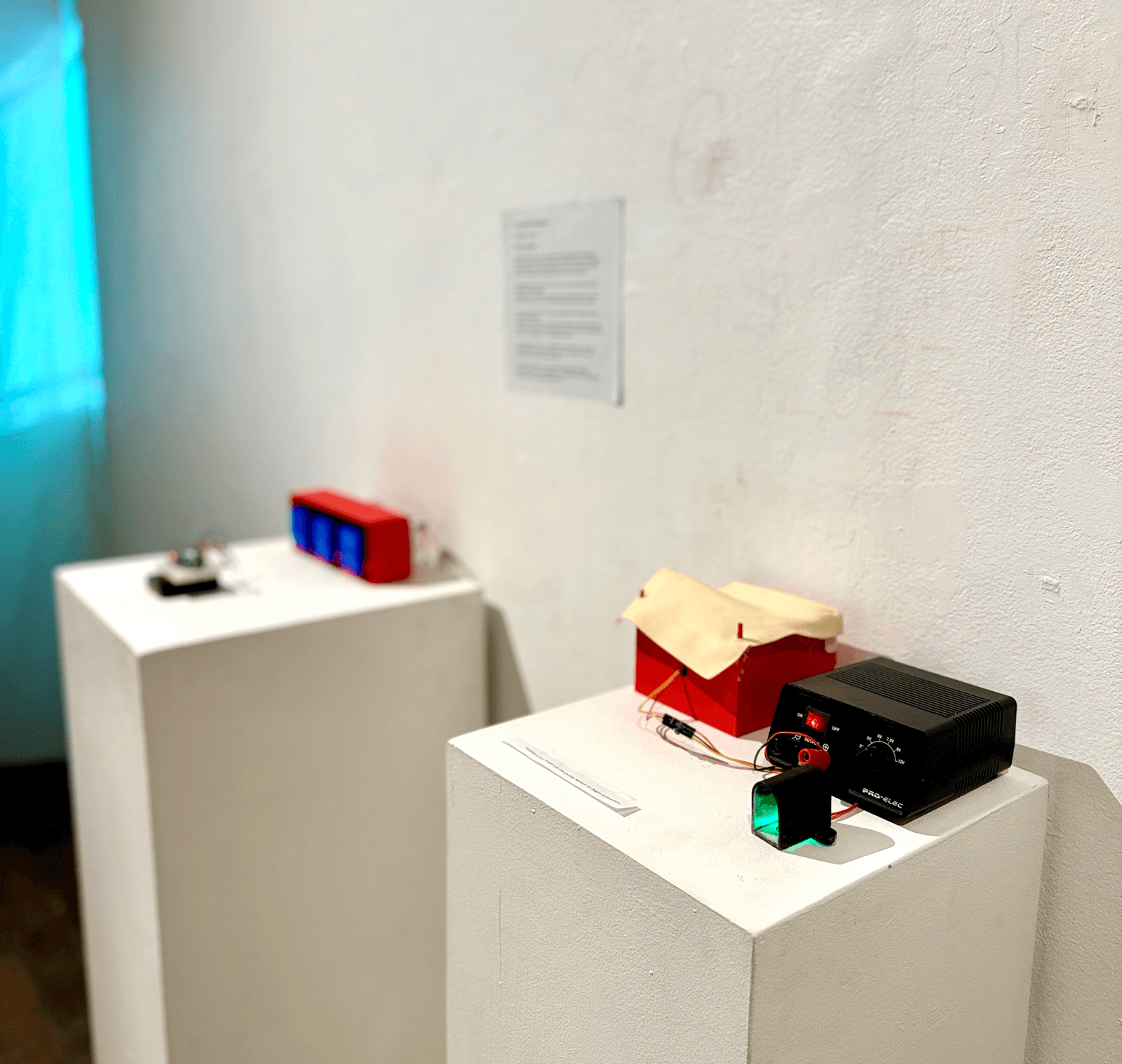
The piece was built with Arduino, pulse sensing and servos, and shown alongside the rest of the thesis work in galleries in Boston, including Boston Cyber Arts Gallery and MassArt’s West End Gallery.
Lesson 1: Design the feeling first, the electronics second
It’s tempting to begin with components. What sensors are available? What can this board do? But when I started that way, I ended up with clever demos that didn’t make anyone feel anything.
What worked was writing down the experience in plain language before touching hardware. “You lie against it and feel a heartbeat that isn’t yours, and it’s calm, slow, and warm.” Every technical decision then had a test: does this make that sentence more true, or less?
That sentence ruled out a lot. Vibration motors buzz rather than pulse. Bright LEDs pull attention to the machine. Fast, jerky servo motion reads as mechanical, not alive. The feeling told me what to remove.
Lesson 2: Every sense has its own timing
One thing I didn’t appreciate at first is that each sensory channel has a different rhythm and a different delay.
- Pulse is fast and rhythmic. It needs to feel synchronised, or it feels fake.
- Breathing is slow and rolling. Motion has to ease in and out, never snap.
- Warmth is slow to build and slow to fade. You can’t switch it on at the exact moment a hug starts.
- Scent is powerful but lingers. Too much, too often, and it becomes overwhelming rather than familiar.
Designing tangible technology means choreographing these timings together. I found it helpful to think like an animator: easing curves, anticipation and rest matter as much as the signal itself.
I believe design should not only solve problems but also spark emotion, create presence, and deepen human connection.
Jawad Farooq Naik, in conversation with Canvas Rebel
Lesson 3: Materials are the interface
On a screen, the interface is pixels. On a tangible object, the interface is the material. Latex, fabric, foam and plastic each change how a signal is felt. A heartbeat through a thick cushion becomes a dull thud; through a thinner surface it can feel intimate. Warmth spreads differently through different fillings.
Growing up around my family’s printing press taught me early that paper, ink and finish change the message. I wrote about that in what a print shop taught me about design, and it applied here almost exactly. The electronics were maybe half the work. The rest was cutting, stitching, testing surfaces and adjusting until the object felt soft and human rather than like a gadget in a pillowcase.
Lesson 4: Hide the machine, but respect the person
The goal of a piece like Huggables is for the technology to disappear. Wires, boards and motors should be buried deep enough that nobody feels them. Noise from servos needs damping. Heating elements have to stay within comfortable, safe temperatures and be isolated from skin.
But “invisible” shouldn’t mean “sneaky.” When a device senses your pulse and sends it to someone else, people deserve to understand what’s happening. In a gallery, that meant being clear in how the work was explained. In any real product, it would mean obvious consent, clear on and off states, and control over what is shared and when. Intimate data needs intimate levels of care.
Lesson 5: Prototype in layers, and test with real bodies
I built Huggables in layers rather than all at once:
- Signal: get a reliable pulse reading and send it between two devices.
- Single output: make one pillow reproduce the heartbeat convincingly.
- Additional senses: add breathing motion, then warmth, then scent, one at a time.
- Enclosure and materials: move from exposed breadboards to a finished form.
- People: watch how others actually use it, and adjust.
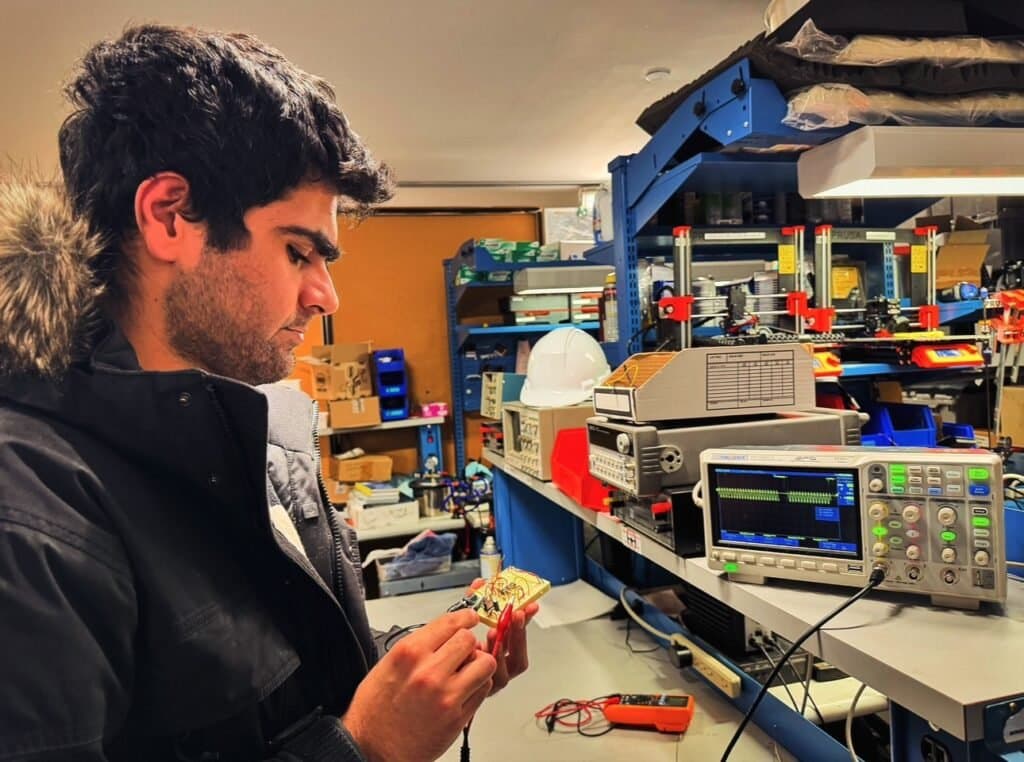
That last step is the one I would never skip. People hold objects differently than you imagine, rest against them in unexpected places, and react to scent and warmth in very personal ways. You can’t design for touch from a desk. If you want the technical side of how I prototype this kind of work, I’ve written a practical Arduino prototyping field guide for designers.
Beyond Huggables: presence you feel rather than hear
Huggables sits alongside two other pieces from the thesis. Digital Embodiment pairs a motion-tracking wristband worn far away with a homing beacon at home, whose three cubes turn and align with the wearer’s gestures and release a familiar scent at intervals. Pulse Paint lets two people who are apart paint together, with pulse sensors turning each heartbeat into shared brushstrokes on screen.
Each one asks the same question from a different angle: what does it take to feel close to someone without being in the same place? That question has followed me well beyond school. At Pinn.Media, it shaped Pinn.Comm, sensory devices designed to ease isolation for seniors. The principle is the same one I learned from Huggables: technology works best here when it supports human connection rather than trying to replace it.
What I’d tell anyone designing tangible tech
- Write the feeling in one sentence before you choose a single component.
- Treat timing and easing as core design decisions, not polish.
- Spend as much time on materials as on code.
- Make the technology disappear, but make consent and control obvious.
- Test with real people early, and let their bodies correct your assumptions.
If you want to see more of the thesis work, the exhibitions and where this all started, visit my journey page or read Tangible Tomorrow on Zenodo.
Building something people can touch?
I love working on projects where physical and digital meet, from interactive installations to sensor-based prototypes and connected devices. If you have an idea that needs to be felt, not just seen, get in touch and tell me about it. You can also browse my other work in the portfolio.