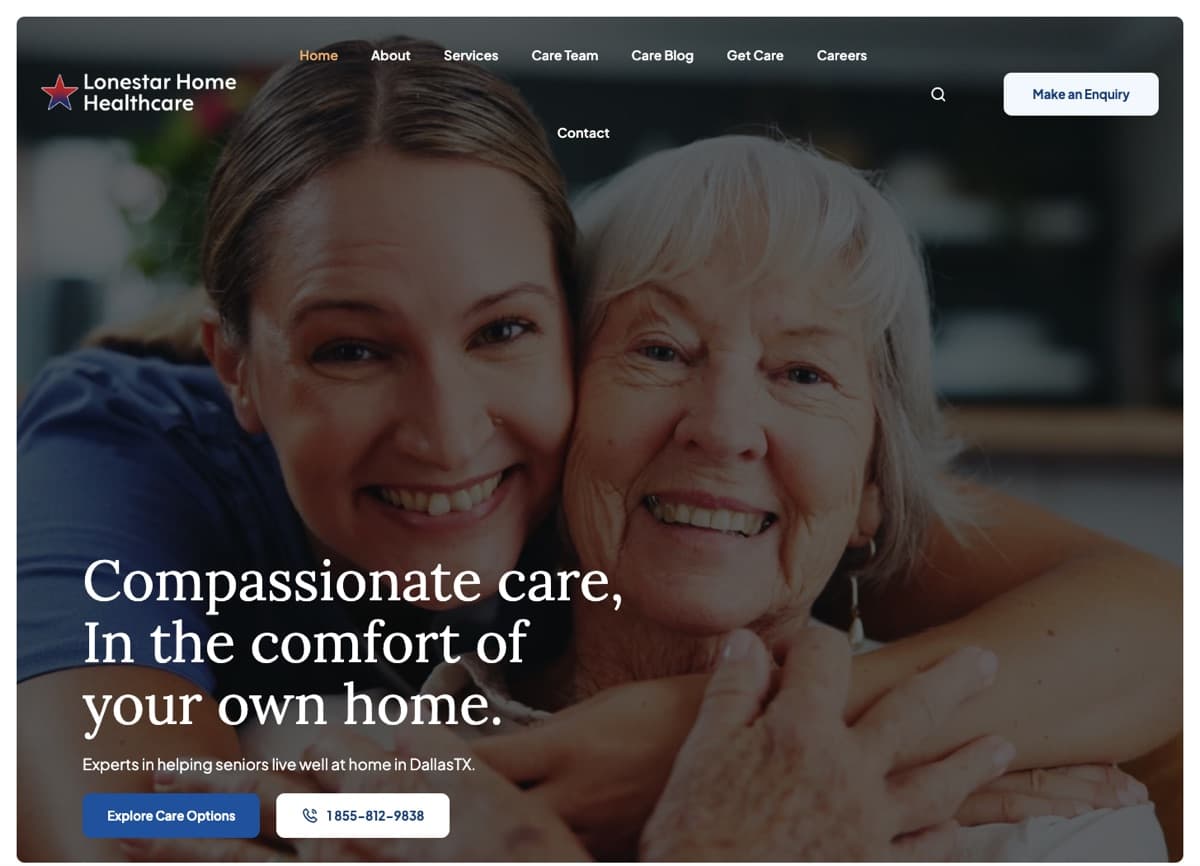
Most people land on a hospice website within a day or two of a doctor saying the word “hospice” out loud. Often it is an adult daughter on her phone late at night, trying to work out what it means, who pays, and whether choosing it means giving up. A hospice website has one job in that moment: answer those questions plainly, honestly and fast, then make it easy to talk to a person.
I’m Solutions Architect at Lonestar Home Healthcare in Dallas, and hospice is one of the agency types I’m building Nuraflow for. This guide is about content: what the pages should say, what they should show, and what they should never say. The best hospice site, to me, explains the same benefit Medicare does, in warmer words.
Who actually reads a hospice website
Before writing a word, I map the readers, because a page written for everyone half-serves each of them.
| Reader | What they need in the first minute | Where it should live |
|---|---|---|
| Family member or patient | What hospice is, cost, where care happens, a phone number answered tonight | Homepage, “Is hospice right for us?”, “Cost and coverage” |
| Discharge planner or case manager | Service area, admission hours, how fast you can assess, how to send a referral | Referral partners page |
| Physician or nurse practitioner | How certification works, how the attending stays involved, who to call | Physicians page |
| Nurse, aide or volunteer | Roles, territory, how to apply | Careers and volunteer pages |
Families get the homepage. Professionals get their own clearly labeled doors in the navigation. I cover the professional side in my home health referral marketing plan, and most of it carries over to hospice.
What a hospice website should say first
What hospice is, in one paragraph
Medicare’s Medicare Hospice Benefits booklet defines hospice as a program of care and support for people who are terminally ill, with a life expectancy of six months or less if the illness runs its normal course, and their families. The same booklet says the focus is comfort, not cure, that care covers physical, emotional, social and spiritual needs, and that hospice isn’t only for people with cancer.
That last point deserves its own line on your homepage. If your team cares for people with heart failure, dementia or COPD, say so by name.
Who qualifies, without a quiz
Under Medicare’s hospice coverage rules, a person with Part A qualifies when their hospice doctor and their regular doctor (if they have one) certify a life expectancy of six months or less, they accept comfort care instead of curative treatment, and they sign a statement choosing hospice. Write that in plain sentences, and add that the hospice team will help the family talk to their doctor.
I would not put a “Do you qualify?” quiz on a hospice site. A checklist that tells a stranger they “may be eligible” in thirty seconds reads as recruitment, and it sits uncomfortably close to the sign-up pressure Medicare warns families about (more on that below).
What it costs, including the parts people miss
This is where I see the most room for honesty. Medicare’s hospice coverage page says there is no charge for hospice care from a Medicare-approved provider, a copayment of up to $5 per prescription for outpatient drugs for pain and symptom management, and possibly 5% coinsurance for inpatient respite care. The same page lists what Medicare won’t cover, including treatment intended to cure the terminal illness and room and board in the home, a nursing home or a hospice facility.
A “100% covered” headline skips the room and board line that surprises families of nursing home residents. A short page stating what is covered, what isn’t, and who to call about Medicaid or insurance builds more trust.
Where care happens, and the four levels of care
CMS’s hospice payment page describes four levels of care: routine home care, continuous home care during brief periods of crisis, inpatient respite care for up to five consecutive days, and general inpatient care for pain or symptoms that can’t be managed in other settings. Families need those billing terms as situations:
- Most days: the team visits wherever home is, including a house, an apartment, assisted living or a nursing home.
- A hard night or a crisis: nursing care can stay in the home for longer stretches until symptoms are under control.
- When the caregiver needs rest: a short inpatient stay so the family can recover.
- When symptoms can’t be managed at home: short-term inpatient care in a facility.
Then be specific: if you don’t have an inpatient unit, say where you arrange inpatient care.
Who is on the team, and when they answer
The Medicare booklet lists the team as possibly including doctors, nurses or nurse practitioners, counselors, social workers, pharmacists, therapists, hospice aides, homemakers and volunteers, and says a hospice nurse and doctor are on call 24 hours a day, 7 days a week. It also says the patient can choose to keep their regular doctor, nurse practitioner or physician assistant on the team as the attending professional.
Turn that into a team page with real people, real roles and a short line from each about what they do on a visit. Put the after-hours number in the mobile header, and make sure a person answers it.
That families can change their minds
In my view this is the most underused section on a hospice site, and it answers the fear behind “are we giving up?” According to the Medicare booklet:
- Before starting, a person can get a one-time consultation with a hospice medical director or hospice doctor, even if they decide not to choose hospice.
- Patients always have the right to stop hospice care, and can return later if they are eligible.
- Patients can change hospice providers once during each benefit period.
- Care runs in two 90-day benefit periods followed by an unlimited number of 60-day periods, with recertification along the way.
It tells a family you are confident enough to explain how to leave.
Support for the family, before and after
The covered services listed in the Medicare booklet include grief and loss counseling for the patient and family. Describe your bereavement program concretely: who runs it, how long you stay in touch, whether there are groups, and whether people outside your patient families can join.
What to show, not just say
Proof beats adjectives.
- Your Care Compare listing. Medicare tells families to use Care Compare to find and compare hospices. Link to your own listing. Its Family Caregiver Survey Rating, built from the CAHPS Hospice Survey, is only published for hospices with 75 or more completed surveys in the reporting period and updates every other quarter. If you have a rating, show it with the date. If you don’t yet, don’t invent a substitute badge.
- Your license. In Texas, HHSC says a hospice must be licensed as a Home and Community Support Services Agency. Put the license number in the footer and on the About page.
- Your service area. A clear list or map of counties.
- Real photographs. Your nurses, your office, your volunteers, with consent. A stock photo of a smiling couple on a beach is the visual equivalent of “100% covered.”
- Admission speed, only if true every day. Same-day assessment is worth saying if intake can keep it.
Patient stories need written authorization and family approval of the final wording. My guide to HIPAA on agency websites covers forms, trackers and chat in detail, and those rules apply to hospice pages too.
What a hospice website should never say
The Medicare booklet has a fraud section that every hospice marketer should read, because it tells families exactly what to distrust. It warns that some scammers try to sign people up for hospice they don’t need, and tells families never to accept perks or gifts for signing up, that Medicare won’t provide “free” services like housekeeping, and not to share a Medicare Number with someone offering free services. It also says no one should ask a patient to sign forms about stopping hospice unless they asked.
Read your own copy against that list. Phrases I would cut on sight:
| Instead of | Why it worries me | Try |
|---|---|---|
| “Free housekeeping and meals for our patients” | Mirrors the exact offer Medicare tells families to be wary of | Describe hospice aide and homemaker services as part of a care plan |
| “Sign up today and receive a welcome gift” | Medicare says never accept gifts for signing up | “Call to ask questions. There’s no obligation.” |
| “Find out in 2 minutes if you qualify” | Only doctors certify eligibility | “Here’s how eligibility works, and how we help you talk to your doctor.” |
| “Completely free, no costs ever” | Ignores drug copays, respite coinsurance and room and board | A short, accurate cost page |
| “Hospice helps patients live longer” | An outcome claim you would need evidence to back | “Our focus is comfort, dignity and time well spent.” |
On referral partner pages, anything that looks like a perk for sending patients raises Anti-Kickback questions, covered in the referral post above.
Tone: plain, warm and specific
Hospice copy fails two ways: too clinical, or so soft a family finishes the page without knowing what happens on Tuesday. What works, in my view, is plain words with warmth in the details.
- Use the word “hospice.” Euphemisms make people search elsewhere for the real answer.
- Answer one question per section with a heading that is the question: “Who pays for hospice?” “Can my mom stay in her nursing home?”
- Keep it readable. Short sentences, no unexplained acronyms.
- Offer Spanish or other languages your community speaks. The hospice patient rights rule at 42 CFR 418.52 already requires rights notices in a language and manner the patient understands, so your website should not be the only English-only step.
Accessibility matters here more than almost anywhere, because many readers are older or reading through tears on a small screen. HHS’s Section 504 rule names WCAG 2.1 AA, and its May 2026 interim final rule moved the compliance dates to May 11, 2027 for recipients with 15 or more employees and May 10, 2028 for smaller ones. I break down what that means in practice in my accessibility guide for agency websites.
A hospice website content checklist
- Homepage states what hospice is, who you serve, your service area and a 24/7 phone number above the fold on mobile.
- Named conditions you care for, beyond cancer.
- An eligibility page that explains certification in plain words, with no quiz.
- A cost page covering Medicare, the drug copay, respite coinsurance, room and board, and who to call about Medicaid or insurance.
- A “where care happens” page in family language, including nursing homes and assisted living, and where you arrange inpatient care.
- A team page with real people and roles.
- A “you can change your mind” section: consultation, stopping care, changing providers.
- A bereavement page with specifics.
- Care Compare link, license number and accurate dates on any rating you show.
- Separate pages for referral partners, physicians, careers and volunteers.
- Short inquiry form, no medical details collected, routed into a BAA-covered system.
- Copy checked against Medicare’s fraud warnings, and a compliance review before launch.
When not to add more
Don’t build a library of twenty articles before the core pages are right; six excellent pages beat sixty thin ones. And skip live chat unless a trained person answers it in real time. A bot that can’t help a grieving visitor is worse than a clear phone number.
Frequently asked questions
Should a hospice website say care is free?
Medicare says there is no charge for hospice care from a Medicare-approved provider, but it also lists a drug copay of up to $5, possible respite coinsurance, and that room and board isn’t covered. I would say exactly that, rather than a blanket “free.”
Can a hospice website include an eligibility quiz?
I advise against it. Eligibility depends on physician certification, and a quick quiz can read as pressure to enroll. Explain how eligibility works and invite a conversation instead. Ask your compliance lead before using any self-assessment tool.
Should we show our Care Compare star rating?
If you have a published Family Caregiver Survey Rating, linking to it is a strong trust signal, as long as you show the date and update it when it changes. Ratings only appear for hospices with at least 75 completed surveys in the reporting period, so smaller hospices may not have one yet, and that is fine.
Want a second read of your hospice site?
Most hospice sites don’t need a redesign as much as a careful rewrite: clearer cost language, a real team page and a phone number that works at night. If you’d like me to read yours with you and mark what to fix first, get in touch.